Advent Advocacy Walk 3: Spiritually Safe for Women in Nature
Wednesday 3rd Dec
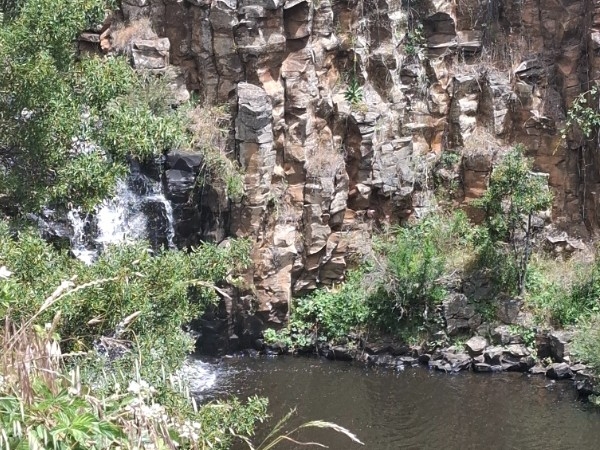
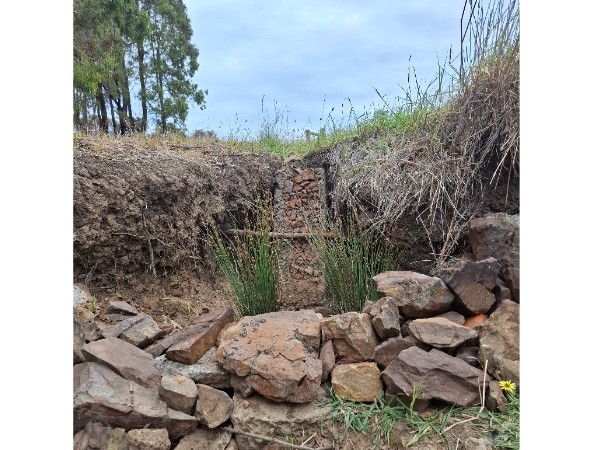
After a torrential rain I did go back to visit the erosion repair site and found most of the wall had held. I may need a truckload more rock, however, and a fair amount of earth embankments dug to redirect the strongest point of flow. I am going to need help with this. My injured leg hasn't pulled up as well as I had hoped from all my traipsing over uneven ground the last week ( as meagre as it has been...I seem to meet the new limit at 5kms every second day.) In pain, I took it slow and sat for awhile in the stillness noticing with joy that many animals had watered there in my temporarily crafted pool this morning. So many tracks!
I sung ancient hymns in the quietness ....in sync with the rotation of the earth and time.....and felt the magnetism of the iron in the ground beneath....the exhale and inhale of wet grass and trees slowing my own to connected calm....and knew again that we are part of a created cosmos laden with Holy Presence.
But a cloud swept over the sun.....and I suddenly felt uneasy. Something dark approached. I remembered that our natural environment is currently full of disorder...in the spirit as well as in its processes. There is need to remain alert and prepared to stand ground to guard what is good from what might seek to harm or hijack it.....as God directs and enables. Women are particularly sensitive to this and often equipped with the awareness and faith to respond.
I believe in religious freedom for every woman but will speak today from my own faith perspective. I agree with Prof. John Walton ( in his book Ancient Near Eastern Thought and the Old Testament) when he describes a Judeo-Christian eco-ethic as belief that nature to be created and beloved by the Creator of all... including all elementally seen and spiritually unseen created realities.
We believe our God is inherently comprehensively morally good and outside the system....while also closely involved, present with, and sustaining the system....the God of gods......not in dualistic competition with anything He has made......but committed to the long work of restorative wholeness whereever free choice has broken away from Him in whom we have our being.
We tend to believe that cosmic phenomena are more of an instrument of His sovereignty than a manifestation of divine attributes....but that we can learn about Him through the revelation of what He has made and loves enough to sustain. We believe that the realm of ultimate power is personal (able to be in relationship with); occupied by Yahweh alone. I think some go too far in suggesting that nature is impersonal ( not something we can be in relationship with). I disagree....but I advocate for a rightly ordered relationship with nature our fellow creation, bestowed with dignity as we are also, and joint worshiper of the One true God. This differs from the worldview of many cultures in the ancient near east when the Bible was written....as it does also today. Many other worldviews have tended more toward conclusions of an enchanted nature as the only personally relatable realm ( a realm occupied by many gods who require appeasement or pleading for arbitrary good outcomes by ritual or favour regardless of their actual inner character), and that all which may be cosmically beyond this, outside of human control and interaction, if anything, is impersonal, distant, remote, or disinterested.
Because I believe in One God above all gods, and one who is good, keenly interested, deeply invested, loving what He has made, and holding His world to standards of goodness (justice and mercy both built into the very fabric of the cosmos) I also believe that nature holds sacred dignity and longs for its Creator and right order... as deep down we do to.
Nature is not evil! It is good. God has declared it so. But it suffers.....as long as we choose disorder over right relationship with the One who is its Sovereign. We, humanity, are somehow connected to this outcome for nature....meant for a beautiful interconnected role.....to be its guardians!
I have absolute confidence in the authority given all believers in Christ Jesus to respond as needed to spiritual as well as physical world matters...and pray that they might encounter Gods fingerprints and joy in nature with calm, courageous, love .....to serve its needs, heal, restore, and evict what attempts to hurt it. When unbidden false spiritual forces are encountered ( often recognisable because of the self- interest, insecurities, or fear they generate) I meet it by prayer to God and as He directs, and in His name tell it where to go....binding all lying tongues ( spiritually)....reclaiming ground for redeemed purposes and the Holy Spirit.
Christ said his followers would do as he did....including setting creation free from captivity to dark powers. All can do this, not only a select few, remembering that it is Jesus name and representation that is effective, the God of gods who has chosen to enter His creation bodily for its healing. I urge women everywhere to consider His claims and seek Him! This is a surer way you can remain safe while in nature and participate wholistically toward its restoration.
It was as I was working with rock.....and contemplating building a nativity scene to story tell our Advent hope.... that a wave of unbidden concepts leaped up with electric force from nowhere...and before me, instead, was everything to build a powerful female figure was suddenly right before my eyes and in hand with compelling pressure to create! As I resisted, (recognising the temptation to reduce faith and art to relatable objects representing our focus, hopes or fears....physical world manifestations of things we wish to elevate.) I was next kicked in the guts by an onslaught of doubt also about all the aesthetic restoration work that I had made. Simultaneously there was also the strangest sensation of a twisted rotten fear. It was like a subtle urged command to "worship what expresses power...or else."....a classic false spirit pincer move.....trying to either corrupt my work.....or compel me to rip everything of structured beauty down, and even second guess ALL earlier handiwork.
I have learned to recognise the trap of attempting by human means to secure safety via supremacy or unholy power....but can be tripped up by fear of mans opinion....
Argh! What a banal dilemma! Although I readily reject any creation or exploitation of art for corrupt cultic purposes....was I introducing what is dangerous into nature just with attempts to create spaces to rest? I am an artist...usually proud and confidently so. Designing is a gift of the Holy Spirit after all (Exodus 31:1-6 and
Exodus 35:30-35). But what if...in building astheticlly what if it all looked too much like an alternative religious shrine down here in the deep dell? Maybe I should tear it apart ! People will visit over the years.....and what will they think...regardless of my intent? More importantly what might they be led to condone, or do that might disorder their own soul! How far does each of our responsibility carry for others choices...etc etc. Maybe I should make it uglier; destroy it a little....make it look more like a rubbish tip eyesore....and less like a place to rest awhile? Maybe i should just leave it a place of ruin again "to keep others safe"....blah blah blah.....or was it: " to stay safe myself"? Ah! There it was. Self-interest.
Such fears are not without basis of course. How many strong creative truthful and courageous women have been accused falsely when they have become inconvenient to powerful men and women....or disconnected institutions.....even via the antiquated "bitch or witch' type slander ( given horrific potency of late thanks to AI)? Many. And increasingly so of late.
I have also endured this form of violence...including a very organised attempt to fabricate defamatory and unrecognisable content online.....leaving trauma scars easily triggered....and so this round of lies, like flies, can start to nip.
Today, being weary, such thoughts twisted on and on, attempting to grip......until I recognised afresh, that the onslaught against women is not only one in the physical realm.
There are powers in opposition to God that prefer a disordered universe and chaos rather than healing. They use confusion and slander and prefer us hamstrung...damned if we do and damned if we don't.
But think about it.....women constructing nature solutions that are also beautiful is what disorder does NOT want. Women or men constructing images that twist reality, claiming worship or offering illusions of secure power via connection with physical or spiritual realm entities is what disordered spirits do want...and this is forbidden by God who alone claims our loyalty.
It is the God of gods who holds my allegiance and heart. To Him alone I bow, create, and worship. So in response to this situation I took the opportunity to reaffirm that, and, (as I had been considering time as a dimension all day) to ask forgiveness for any ancestors who had ever practiced anything else. I sensed freedom in the air and breathed of it deeply before laughing out loud with my feet planted firmly on Gods good earth! What a way we humans have, when left to ourselves without Gods words/good ways/and presence to guide us......to so easily fall into error one way or the other......especially giving way to vapours of fear or pride!
This is where the Light of Gods revelation by His Words- ( The Jewish Torah) and by His personal incarnation (Jesus the Messiah) becomes so valuable an aid to an abundant life of wholeness. He has not left us in the dark concerning right and wrong.....and what He longs for is our freedom to walk in the Light. His laws are not burdensome as so many have heard. They are what Love looks like in action. And in day to day situations such as I found myself in today, they are a solid guide of how to walk with Him. My artistry is inspired by the Holy Spirit but to know that Spirit truly I offer it in His service knowing that His Spirit will never reveal or inspire something that outright contradicts what He has already revealed. Considering the fullness of who God is was all so banal compared to the earthy glory around me! It was humbling and refreshingly so to realize this. Reality is such a better place to live from.....with humanity acknowledging our rightful place....(not gods) but creatures beloved...and rising into our true identity. It is truth that sets us free...bringing victory to set the world free also! Truth!
I worship the Lord Jesus Christ, the Son of God, who has come in the flesh. He has called us to a steady work of redemption, carrying it right into the heart of every broken place. So I stood up and rebuked the lies in His name... and they fled. Sometimes a firm resounding no is required to be spoken to all that falls short of our Creators glory! By the light of truth (even that of laughing at the ludicrous) darkness was exposed...and in that one small part of the planet, anyway....its time was done!
I pray that God's blessing and guidance will anoint the vision, beauty and creativity in the heart of every woman and they will rise in these lands...and across the world to use authority or power well. I pray, also, that women and men, every person together, would both love beyond self...and cooperate to heal the earth and the people....each in their own way with humility and honouring collaboration.
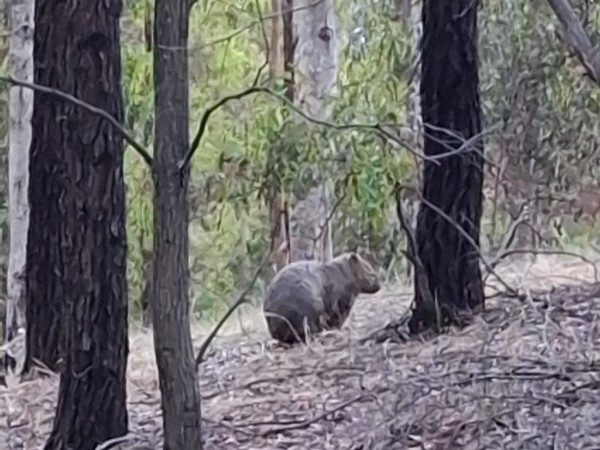
Just then I looked up to see a beautiful she-wombat, strong and immovable as a boulder in her natural habitat....in complete confident security. A creature, fearless; exactly as she was designed to be in exactly the environment designed for her; like a great Queen of the Bush....She carried such dignity!
There is no need for women to remain nervous about the ethics of a deep connection to nature. Of course there are paths we might stray but with humility, teachability, dignity and discipline there is a totally legitimate wholesome wholeness! Before the face of God our Maker we are free to fully express ourselves with this same kind of steady confidence ...in our perceptions, our contributions, our philosophy, art, work, and also in faith...in nature; both, in the private places where we have dug our burrows and in the public places where we have forged our paths.
I think women interconnect so deeply with our natural environments.....it is like coming into who we were made to be....and this feels powerful....because it is who we were made to be.
Of course we are all well aware of how often every form of our own power or skill lived in wholeness and full expression can be misinterpreted as a threat and punished by those who don't understand or recognise it as a gift for all.
It can also be contaminated by dark forces for we too are responsible for our choices and self-ishness or lust for toxic personal power. Women as often as men, whether atheist or religious, can fall for the error of making a "god" in our own image. This error is common to humanity and must be turned away from.
Power is God given to all of us, made to be wielded with steady hope WITH him! What we choose to do with it, and what we facilitate by it, and also how we lay it down when called upon for the greater good...this is what matters! Let's do so in the service of God, in correct posture before Him who bestows it, and in alignment with our faith or values!
Yes, historically, much of what comes naturally to us has made others afraid. But the Bible teaches: " It is perfect Love that casts out fear."
Imagine a world where revelation of what an incorruptible Love perceives was received beyond fear; a love that is stronger than all false power; and what if what Love freely gives and receives was welcomed instead as a gift of the Creator?!
It is good news that Jesus Christ never diminished women's unique powerful contribution, perspectives, handiwork, or insights.... and neither will I diminish my own or others ( from abandonment or by settling for any kind of compromising corruption that promises false power, self- glorification, or falls short of Love).
Jesus respected women. He honoured them by re-introducing God to women as their Creator, Lord, Hero and Restorer....their friend; safe refuge for their whole person, the One God to whom it is most appropriate to devote their strength in worship....and He, their King and Protector.
I always encounter the Living God when I am in nature or around human creativity.... in ever increasing awareness as I age. It is a wonder! And in knowing Him better I know myself better also (as I am, as we all are, made to be a reflection of Him). My faith always emerges with greater understanding or insight from time alone in nature.
This is not a matter for others to "control". But rather, we answer directly to God while also welcoming the accountability of Gods word, the witness of tradition and His community. Women should be safe everywhere always to enjoy and responsibly bestow their unique redeemed gifts of awareness, creativity, and guardianship to the world within a right spirit....and these should be welcomed, honoured even, as an essential symbiotic balance and source of wisdom alongside the gifts and contributions of others when they are bestowed. Rather than being threatened by what sounds foreign, one essential thing I would urge at this volatile time is this: With wry awareness of spiritual, human, and natural world tendency to disorder......we should actually start by assuming positive intent....and enjoy taking part in the goodness of nature.....because God is greater than all of it and nothing can thwart His will for restoration.
I concur with this reflection:
"It seems strange to say, but what can help modern man find the answers to his own mystery and the mystery of Him in whose image he is created, is silence and solitude; in a word, The Wilderness.
Modern man needs these things more than the Desert Fathers and Mothers- the hermits of old.
If we are witness to Christ in today's marketplaces, we need silence. If we are always to be socially available, not only physically, but by empathy, sympathy, friendship, understanding, and
boundless "caritas", we need silence. To be able to continue giving joyous, unflagging hospitality, not only of our homes and food, but of mind, heart, bodily strength and soul....we need silence.
Some need silence to gain courage to re-enter the world....others need community to help them gain the courage to go into silence.
True silence is the search of any person for God.
True silence is the speech of lovers; for only real love knows the beauty, completeness; the utter joy of the beloved.
True silence is a garden enclosed where, alone, the soul, can meet with its God.
It is a sealed fountain that He alone can unseal to slake the soul's infinite thirst...for Him....the Creator from whom we come. Our home is found again in the silence. "
( From : The Finan Readings- Celtic Daily Prayer Guide- Lindisfarne Community- Book One- December 3rd)
+++++++++++++++++++++++++++++++++++++++++++++
Here, also is a rambling essay reflection I wrote recently as I pondered the reasons I love the natural world and carry strong motivation, as a Christian, for its care. Not everyone will agree with these reasons....and that is ok.
I share it here so that, perhaps, it will encourage other women, no matter what your belief background, to write, think, bridge, interact, bounce ideas off each others perspectives and share with ecumenical courage at this crucial intersection of planet and politics....to interact rather than react....to come together and build alliance to do what we MUST together: discover robust solutions to both the climate crisis, our communities, and the spiritual wasteland we find ourselves in at this time for the sake of life and peace. Women have always risen in darkest times to lead and once again we will find a way to carry the world forward on our hips with grace.
*****************************************************************
REFLECTIVE ESSAY:
Shaping viewpoints and a resulting practice of eco-theological ethics may be one of
the most important matters for communities of faith to discern in our day.
A Christian viewpoint is uniquely derived in
reflection on God’s identity and relationship as Creator to His Creation. Scholars suggest
contemporary thought now places God’s care, governance, and order of creation as central to
any teaching on God’s providence, and providence central to natures care. 1
“God’s ideas underpin creation, and it is understood as the fruit of God’s infinite goodness.”2
Also, the desire of a good God for cosmic reconciliation is something we receive, align, and
participate with; following Christ to carry redemption throughout the created order; informed
by His own divine generosity, hospitality, peacekeeping and justice. We do so because we believe these things are not just human constructs but originally built into the
fabric of the universe. 3
Theologians, Douglas and Moo, propose several reasons for a robust eco-theology of
“creation care” by the church: The urgency of current climate challenges; a modern virulent
re-emergence of humanism/transhumanism that seems intent to plunder the earth; a thought
leadership vacuum inadequate in response to inadequate worldviews, which is something only our faith communities and churches can speak to.
For Christians it always starts with right positioning....a posture of humility that acknowledges the existence of an Other who is not us...and this Other utterly Sovereign, Wise, All Knowing....and Good. Where there is trouble we acknowledge and define the age old problem (i.e. man’s fall from how he was made to be.....to "do life" WITH God....and original sin: The I'll do it my way" nonsense and the breaking of holy laws designed for our benefit to teach us how to live in relationship. The church can also present afresh the gospel (God’s just mercy) in appropriate action, including rapid response to
nature’s needs. They suggest, in so doing, we discover God and our own identity again in harmony; revealed as the family of God upon which nature flourishing depends. 4
Christian concepts of creation and Creator as distinct, of worth, and within healthy
relationship, are in sharp contrast to ideas of a non-divine material
universe; views of the physical realm, creator and fleshed creatures as evil....something to be escaped from; of the material universe pre-existing Gods manipulation of it; or of the worship of lesser created spirits via a physical channel.
Creation care was integral to the very first followers of Jesus, and remained church tradition until some forms of heresy began to push it out.
Athanasius (one of the early church's leaders
(c. 296–298-2 May 373),urged the church’s manifest care for
Gods good “handicraft” saying, “it is unseemly it should be done away, either because of
carelessness, or the deceitfulness of evil spirits.” He refuted false teachers who taught Christians to exploit or ignore the earth, and presented the good God’s remedy of the victorious Christ, the Divine incarnated into natural world form, as our leader in its preservation.
5
Athanasius presented the Supreme God of grace as an all encompassing “Good Father” revealed by nature (Acts 17: 16-31) who “by the divinity of His Word, and of his universal Providence and power...orders all
things; all things being moved by him; and in Him they are quickened (to life).” 7
He issued a clear
summary still resonating today of what happens when man rejects God, saying, “Death gains
on men; corruption abides; humanity perishes; rational image bearers of inherent dignity
disappear; and the handiwork of God is in process of dissolution.”
9
To establish Gods existence and goodness he recalls the church first to humility, via an awed focus on the obviousness
of an intelligent Designer or “Mind” intentionally making the vast complex diverse
environment in which we are placed. (Rom 1:20) saying that without “Mind” “all would be
uniform and without distinction,”
Catholic scholars such as O’Brien echo Athanasius saying the sheer variety of
biodiversity reveals God and must, then, be approached sacramentally. Ancient biblical prophecies such as Isaiah 45:11-12 also present as miraculous the fact of creations continued existence, despite the curse; liveable rather than a
chaos; fit for life and animal/human habitation. This, too is evidence that the Intelligent Designer is a good welcoming God who rules the cosmos. Only a benevolent divinity could sustain such a balance of life.
O Brien admits that thriving natural bio-diverse
ecosystems do, however, also seem dependant on cycles of predation and extinction but suggests even this
points to God’s good purpose as a mystery beyond our finite understanding, inducing proper
humility to worship and study as our legitimate foundation and focus; while providing caution and context to any simplistic attempts to pattern human society on such a model.
10.
With him, I believe that a fully sound ecological ethic, cannot be derived from simplistic observation of the natural world alone, which dwells temporarily under a curse of entropy, (i.e. Micro-evolution). The environment is currently “red in tooth and claw” but scripture links the fate of humankind with the fate of the created cosmos and our natural environment. Just as it affects us....our state of being affects it! The "Fall of mankind" away from healthy relationship with God has led to the subsequent curse placed on our environment. (Gen 3)
Augustine said, “Evil is (defined as separation from God) and is so contrary to nature ( which remains loving and beloved by Him) it can do
nothing but harm nature.” 11
He discusses how autonomous human vice erases Gods order or "ways"; yet God chooses to re-write His laws on repentant fleshed hearts. Augustine explained, “It is not by nature that grace is denied, but rather by grace nature is restored.” 12
(How often the church has got it wrong and failed to apply its own teaching!!!)
A healthy Christian ecological ethic will then depend on a proper Old/New Testament understanding of the atonement as God’s activity to reconcile in “at one-ment” with a universe in conflict or disorder; not by domination or subsumed sameness....but in reconnected unified relationship. 13
Athanasius, again was first to propose Trinitarian doctrine as essential to Christian eco-ethics. He spoke of a different take on natural biodiversity, stressing that its vast symbiotic unity despite chaos is clear evidence of a creative means by which it is made and remains. He identified Jesus as The Original Creative Word/or Logos who divinely
incarnated, and as member of the Trinity, is active in united diversity and mission. He taught that The
Christ, directed by His Father, and empowered by the Spirit has been implementing creativity and mercy throughout time, saying, “The renewal of creation is now wrought by the Self-
same Word who made it in the beginning.” 15 Mchall agrees that the locus classicus of the doctrine of Romans 5 :12-21 is the Word incarnate reversing death; redeeming all things, and gifting resurrection life. 16
Van der Kooi agrees God is Creator Eternal- Lord of time and space- not perishable or
transient; God does not need creation, Creation is distinct from God- different (perishable,
transient, i.e. “interesting in itself”), Creation is not a part of God but a gift from and by Him;
its purpose to reflect His “nature” as Life, and sustain Life, so as to bring Him glory. Van der Kooi says,
“according to Karl Barth, Gods purpose for creation was covenant with man, but we must rethink
anthropocentricity in light of the vastness now discovered of the non-human universe.”
17 He is careful, though, to offer balance by reminding Christians that conservation is never “passive acquiescence, but
God’s activity and struggle for life” via the Spirit that raised Christ, Giver and Restorer in
“ongoing creative means” 18 The church, ( and all people of faith) then, can expect consistency of the Word, the Spirit, and real life application to avoid extremes that dishonour human life and agency among the
wider needs of the earth. Man, unhealed is part of the problem, but not the planetary disease.
We should seek a wise interdependent balance led by mercy, not death or “culling”; neither
an Anthro-free wilderness or a clinical technocratic transcendent utopia but a well stewarded
planet. And, for Gods sake! There is absolutely no need for concerns of evolutionary "lemming cycle" collapse to be used to justify subjugation of women in order to preserve Western civilisation! ( See book titled "BioHistory).These are incomplete views based on fear and selfishness; and they totally miss the fact that there is more to the cosmos than mere material observation. There is also revelation! Divine revelation teaches that when men and women work together as co-regent caretakers of nature with God's guidance, they hold an identity, an ability, and a collaborative action together in stewardship that is powerfully effective to find best paths forward in ways that are far higher than simplistic reductionist viewpoints would have us think. They can actually beneficially reign over natural processes.
It is my firm conviction that civilisational collapse has occurred in the past at similar intersections as what we now face...because men tend to panic.....react and try to control women....scrap over last resources....and thus fall prey to entirely avoidable environmental depletion. There is no need to repeat histories mistakes. We now have the advantage of being informed via research of the past which gives a good heads up. Again, from a faith perspective, there is hope. Athanasius concludes, “It were not worthy of God's goodness that anything He has made should waste away, because of the deceit practised on men by the devil.” He presents the victorious incarnate Christ, defeating the devil who had held unredeemed earth and man captive to destruction, as the good Gods remedy for the entire cosmos. “Christos Victor” is also presented as part of Irenaeus' defence of practical faith via what some call the “ timeless Ancient Near East/Asian picture of the future reign of God on earth”.20 It is, however, a crucial doctrine worth revisiting.
Christian participation to “ransom the earth” may involve exchange via new unregulated trade markets but it is obvious these must be shaped by a truly holistic ethic of moral integrity. “Nature economies” without morality, even when modelled on nature but without
God, will not save a dying planet. Generosity based eco-theology, however, extends a vision beyond the mere transactional, skull-duggery, and predation so defining of previous markets. We would do well to explore these models more fully.
Astronaut, Ron Garan, considering earth life fragility, suggests a radical shift in our hierarchies: planet first; then society; then economy.21
Van der Kooi urges societal recognition of the checks and balances of “common grace”, greater courtesy in humble acknowledgement of others with respect of their inherent dignity and rights; as well as willingness to sacrificially share space, resource, time, and being in radical generosity on behalf of the wellbeing of others as Christ has done. 22
(Phil2:5-11)
When human and non-human creation is observed as revelation of God the revelation must be
further revealed by the whole Word. An eco-theology of generosity can be derived in part from nature, and is clearly taught through much of Scripture, but is most clear in the creation account. (Gen 1-2) when God created humanity both male and female as Imago Dei ( made in the image of God).....the ultimate expression of His Divine generosity when He made space for something else to exist.
In academia Cortez asks us to extend this thought
suggesting that nature as also image bearing, reflective of God. 23 But "image bearer" is more than a personal identity or rank.....it is a unique calling, purpose, and missional vocation. For the non-human creation I prefer the term “dignity- bearer” in discussion of our equal dignity with the earth. This is because God originally bestowed inherent non-merit based worth on both mankind and the natural earth declaring each of us equally “good”.... and we all retain this rightful dignity despite the falling away that has occurred.
When we recognise our equal dignity, Christians can know Earth as a beautiful fellow creation; a formed natural world triad, in relationship with the Divine Triad who made it. We begin to see a beautiful synchronisation in how we were designed to interact. Scripture says Adam was formed from Earth.... Eve formed from Adam.... Humanity formed from every Woman who has since birthed or nurtured....Earth then formed or shaped constructively to the extent we give toward its wellbeing.
This is why relationship between humans, with one another and the earth thrives in recognition of inherent individual dignity, while also remaining deeply interdependent on continuous selfless generosity! This is also why it is imperative the church set aside ideas of
domination to instead consider the “dignity-bearing” connected participants in God's creative
processes.
24 Humanity is responsible for the wellbeing of a jurisdiction (a dominion) not to its subjugation unto bondage. 25
As we have received, can we now lead to create space for each to gift a part of self to the other? 8
The mandate of the original image bearers was to actively reign together in various strength
and stewardship of this process (Note: The Hebrew word radah or reign has been badly
translated “subdue”); and this as joint allies with woman described as “ezer keniggdo” = an
ally; a mighty force in common cause. Free willed man, woman, and non-human nature bow
together to the authority of God, for the glory of God.26 All three were mutually commanded to participate in nature’s increase “multiplying and filling the earth “, a celebration of life, but humanity was solely ordered to do so within obedient limitation, gifting themselves in dignified reigning service.
It was a mutually gendered active tending, training, guiding of good florid abundance into balanced fruitful symbiotic well managed environments, as God showed them by planting the Garden while also declaring the wilderness good. In this situation nature and humanity could all thrive; food was effortlessly obtained as a gift of God via nature, with respectful limits set by God to teach self-limitation, building humanities trusting reliance on Him, also preventing exploitation. (It is interesting that trust was the first thing exploited in this origin story.......a tactic of evil that continues today.) (Gen 1-2). Christ and the true "church" across the world, His Bride, will lead the way to this beneficial reign in service of God and Creation.
An eco-theology of relational reciprocity rather than cold transaction or contempt coinage is found, also, in recognition of cosmic hospitality as a multi-way exchange. No part of the cosmos or humanity can thrive without dependence upon God as our Homemaker, and no human can survive without dependence on the hospitality of nature to sustain us. Van der
Kooi suggests that “preservation of the earth as a habitable house for the future will require
renewed reflection on themes like God’s providence, his concurrence and reign.” 27 This means....we can trust Him. We act in hope of a future despite suffering, knowing God has got this, as His response to Job
9 demonstrates His ongoing powerful sovereign interest to sustain life across every detail of His world.
(Job 38)
Meanwhile, Creation is not passive. It is said to groan and labour like a woman suffering childbirth, which also implies natures anticipation/ and participation (along with that of Gods Spirit, who groans in intercession on our behalf) to support a universal new birth and freedom ahead. The Spirit of Life already gives life to the mortal bodies He indwells, setting us free from slavery to sin, death, and fear; but soon we will be revealed immortal as “children and heirs of God” with the Messiah who has also suffered and was glorified. (Rom. 8) Our
complicity in natures suffering can be reversed, and good stewardship restored, with the mutual recovery of right God-Man-Nature relationships and our active participation to follow where Christ invites us; as nature and social restorers; ambassadors who embody His
kingdom in our time. 28
Ambassadors implement protocols of honour appropriate to the context in which they serve.
Mari Jooferstad proposes many texts of Hebrew scripture (Jer. 2:12, Joshua 10: 12, Deut.
4:26; 30: 19; 32:1) indicating an ancient Jewish view of the non-human creation as alive, personalistic and interconnected with human personhood; not just raw material, and not divine, but itself holding sacred inherent dignity; creaturely active to “hear and obey its
Creator”; existing in aggrieved lament of man’s abdication or mismanagement of its care; worshipping God in faith; and participating with Him to affect human history. 29
Nature is sacred but I am highly uncomfortable with any reference to “new animism”. Jooferstads rightly applies Martin Buber’s thought as a corrective: “In approaching nature relationally we neither project our self onto it or interact with a pantheistic spirit or “soul of a tree” but rather recognise that “the Thou of the tree is tree itself” (and not in a particularly mystic sense). Buber said our service of nature is inspired as we observe its dignity with awe: “Look! Bound about you beings live their life, and to whatever point you turn, you come
upon being.” 30
Accepting this requires the immediate adoption of socially courteous language and interaction with (an etiquette of gratitude, and respect) which Jooferstad urges as the appropriate response to nature’s own responsible generosity, in service of God, to sustain us.
(Gen 1:16; Lev. 25:2,19; 26:4, 34-35; Deut. 11:17; Isaiah 24:4; 33:9; Jer. 4:28; 12:4,11;
23:10; Hosea 4:3; Joel 1:10; Amos 1:2, Micah 6:1-2, Judges 5:20)
The church, rather than interacting from ego, or exploiting resource, should provide opportunity for people to engage with nature restoratively, recognising the human longing to integrate with natural beauty, the
God whose dignity is reflected there; and learning that self is in context. It should support great honour of natures need via things we can give it, such as sabbath rest via symbiotic rotational rhythms in agricultural, forestry, conservation, fire, and development
practice.
Like Jooferstad, I find Chickasaw leader, Linda Hogan’s covenantal framing to this end
compelling. She writes of destruction wrought from “broken treaties” with land and animals.
This aligns with my understanding of Lev 26:42, where God, Himself, maintains a covenant with the land; example of our original mandate to steward nature well by remaining faithful to our joint covenant with God. A nature treaty would speak truthfully of what has been
problematic and negotiate mutual needs in future balance. The subsequent creation of an
30 Martin Buber, I and Thou, trans. Ronald Gregor Smith (Edinburgh: T. & T. Clark, 1950), 7, in Joerstad, The
Hebrew Bible and Environmental Ethics: Humans, Nonhumans, and the Living Landscape, 6.
31 Edwards, L. Clifton. Creation's Beauty As Revelation: Toward a Creational Theology of Natural Beauty, Wipf &
Stock Publishers, 2014,237.
32 Edwards, L. Clifton. Creation's Beauty As Revelation: Toward a Creational Theology of Natural Beauty, Wipf &
Stock Publishers, 2014. 164-166.
11
enduring social compact or covenant with nature should then be something for which the
church advocates.33
Social courtesy toward nature, human or otherwise, will apply the wholeness of shalom
(peacekeeping) as well as of justice. Not just an individualistic approach, but a communal,
even a multi-generational ethic passed down within the family based on our Fathers character
as the giver of all gifts in non-competitive but just relation with His creatures. (Psalm 19:3;
Psalm 145: 4; Psalm 22:30-32) It requires firm protection of social capital, as well as physical
investment; and enough safe stability to foster radical generosity. Cole warns that those at
odds with God feel most comfortable in a disordered universe, and earth may need protection
from the ruinous. 34 The church should support the strengthening of legislation and
implementation of great cross-border penalty for money-laundering trafficking crime mafias;
for abuse or deceptive undermining by fossil fuel or the arms industry; it must apply firm
discipline, consequence, and restorative discipleship for domestic violators and liars. A
national database of sexual predators would also be effective deterrent in honour/shame
cultures such as Australia to clean out and re-order the legal/judiciary/ government/church
and family quickly. Rasmussen points out that “the forces which separate humanity from the
non-human world, also separate us from one another.” 35 When interpersonal human relations
break down, nature suffers, leading to more human suffering. I agree with Gunston who said:
“Care for creation does not require a crisis to be justified.” but I raise my voice with an eco-
feminist cohort, who rightfully stress the need for creation crisis preaching as a matter of
urgent social justice not only for the planet but for every marginalised group, including
women and people of colour, who are all at imminent risk from an unmitigated continuation
of patriarchal eugenic dominion tactics. 36 37 Kohak suggests “alienation sets in when
humanity loses awareness of the presence of God...(reducing all to) cosmic accident;
meaningless; mechanical.” I would add that re-emergence of gnostic heresy also threatens
nature and must be swiftly condemned. Instead, the truth, justice, and reconciliation between
persons, so foundational to justice for nature, is biblically based on Gods own desire to
reconcile.
38We can accept His “view of all the cosmos as created, belonging to Him, the
Creator, endowed with value in the order of being, a purpose in the order of time, and a moral
sense in the order of eternity.” 39 (Gen 1-3, Luke 1: 26-38) Northcott extends this, rightly
stating the importance of environmental management as a matter of justice for the poor who
are most affected by environmental degradation. He recommends the churches specific focus
to empower communities and families to implement biodiverse and localized generous
service to marginalized human beings, species, and land. 40
Jooferstad provides an accurate challenge to western tendency to take responsibility only for
the soul, arguing for a return to equal responsibility for our individual and collective bodies
which must also be “made and maintained”. 41 She suggests that, like the Torah which reveals
the soul’s life source found in God, nature also reveals God as life source of the physical
realm. 42 Our observation and support of scientific data, and involvement in further development of scientific theory and natural philosophy, is crucial, even when experimental. 13
At the same time, the church should not hesitate to “read” nature through the consistent lens
of biblical redemptive and proactive blessing to see a more complete natural narrative, discern what is missing or flawed in human and non-human being, thinking, and behaviour; and confidently expect to meet the true God there. Richard Bauckam establishes the central
importance of physical and spiritual worship to creation care; but, he notes, we praise YHWH in tangent with nature (Isaiah 44:23; Psalm 148, Psalm 98: 7-9; 148: 3-10) “overhearing an interchange between God and parts of his world”...... rather than receiving direct communication
from it ourselves. 43 Indigenous Christians ( and scripture) witness a broader view.......that God speaks to us all the time through everything He has made. Baukham helpfully suggests, however, that this joint worship of God provides “the strongest antidote to
anthropocentrism in the biblical and Christian tradition.” 44 Indigenous Christian theologians
concur and advocate for a regular practice of “deep listening” to inform our worship of the
One God whose Creation Song still reverberates in geographical reality...His song for that
place, and the song of the land’s response overheard and offered back, with participation.
45
I conclude with Cole that. “Ultimate fulfilment of God’s intent to reconcile, heal, and restore his
creation will be “relieved by the return of Christ, the resurrection of the body... and establishment of the new heaven and earth.” 46
Meanwhile, perhaps a reintroduction of parts of one of the very earliest Liturgies of Christian faith....the Liturgy of St Mark (mentored by St Peter), could assist to remind us that creation, by God and man blessed, is closely linked to the person and work of Jesus. 47
Our learning to care with respect for human and non-human creation is, then, vitally
important, because God cares....and respects it. (Psalm 104: 10-28) Scripture teaches that where once were
weeds and thorns, nature will ultimately flourish like a garden; rejoicing in worship as God Himself, who ever intervenes, restores humankind and the land.
And so, our thriving is also linked to nature’s thriving by
God’s grace. The garden of life and land will become an observable phenomenon bringing
fame to God as “an eternal and imperishable sign”! (Isaiah 55: 6-13) In prophetic
collaboration with God, then, we act with hope toward mutually beneficial outcomes and will discover the best practical way forward to serve its life.
1 Kelly M. Kapic, and Bruce L. McCormack ed, Mapping Modern Theology : A Thematic and Historical
Introduction (Baker Academic, 2012),161
2 Matthew Levering, Engaging the Doctrine of Creation: Cosmos, Creatures, and the Wise and Good Creator,
(Baker Academic, 2017),10-11.
3 Van der Kooi, 428.
4 D. J. Moo, & J. A. Moo, Creation care: A biblical theology of the natural world (Grand Rapids, Zondervan,
2018), 23-24.
5 Archibald Robinson, St. Athanasius on the incarnation (London: David Nutt Publisher, 1891) 11.
6 Graham Cole, God the Peacemaker, 82.
7 Robinson, A. St. Athanasius on the Incarnation, 32.
8 Robinson, A. St. Athanasius on the Incarnation, 10.
9 Robinson, A. St. Athanasius on the Incarnation, 10.
10 Kevin O Brien, An Ethics of Biodiversity: Christianity, Ecology and the Variety of Life (Washington:
Georgetown University Press, 2010) 70.
11Augustine, De ciuitate Dei, cap xi, 17 [ CLCLT 9 PL 41.3310]
12 Augustine, De spiritu et littera, cap xxvii [CLCLT (PL 44.229)]
13 Moo, D. J., & Moo, J. A. Creation care: A biblical theology of the natural world, 23-24.
14 Kelly M. Kapic, and Bruce L. McCormack Mapping Modern Theology: A Thematic and Historical Introduction,
ed. (Baker Academic, 2012), 161.
15 St. Athenasius, On the Incarnation, Craven lecture notes, Ridley Bible College, week 9
16 Thomas H. McHall, Against God and Nature: The Doctrine of Sin, (Crossway, 2019).
17 Van der Kooi, Cornelis. “Creation and Providence.” Pages 420–433 in The Oxford Handbook of Reformed
Theology. Edited by Michael Allen and Scott R. Swain. Oxford: Oxford University Press, 2020. 424, 427,
18 Van der Kooi, 430.
19 Clyde and Rosemary Rigney, Ngarrindjeri in Valuing Traditional Conservation: Reconnecting Ecosystems,
video: https://www.re-tv.org/articles/reconnecting-ecosystems, 21/09/2025
20 Robert M. Grant, Irenaeus of Lyons, (Taylor & Francis Group, 1996).
21 R. Garan, Floating in Darkness: A Journey of Evolution. (Something or Other Publishing, LLC. 2021), 82.
19 Clyde and Rosemary Rigney, Ngarrindjeri in Valuing Traditional Conservation: Reconnecting Ecosystems,
video: https://www.re-tv.org/articles/reconnecting-ecosystems, 21/09/2025
20 Robert M. Grant, Irenaeus of Lyons, (Taylor & Francis Group, 1996).
21 R. Garan, Floating in Darkness: A Journey of Evolution. (Something or Other Publishing, LLC. 2021), 82.
22 Van der Kooi, 430
23 Marc Cortez, Theological Anthropology: A Guide for the Perplexed, London: T&T Clark, 2010,
24 William Leiss, The Domination of Nature, Montreal: McGill-Queens University Press 1994, pages 30-35
25 Graham Cole, God the Peacemaker, 82.
26 Van der Kooi, 431.
27 Van der Kooi, Cornelis. “Creation and Providence.” 421 in Oxford Handbook of Reformed Theology. Edited by
Michael Allen and Scott R. Swain. Oxford: Oxford University Press, 2020.
28 Moo, D. J., & Moo, J. A. (2018). Creation care: A biblical theology of the natural world. Zondervan, Grand
Rapids, Michigan pg 28
29 Mari Joerstad, The Hebrew Bible and Environmental Ethics: Humans, Nonhumans, and the Living Landscape,
Cambridge: Cambridge University Press, 2019) 2-3.
33 Linda Hogan, Dwellings: A Spiritual History of the Living World (New York: W.W. Norton, 1995), 11. In
Joerstad, The Hebrew Bible and Environmental Ethics: Humans, Nonhumans, and the Living Landscape, 8.
34 Graham Cole, God the Peacemaker, 81.
35
36 Colin E. Gunston, Christ and Creation (Grand Rapids: Eerdmans 1992), page 105
37 Leah D. Shade, Creation-Crisis Preaching : Ecology, Theology, and the Pulpit, Chalice Press, 2015.
38 Cole, God the peacemaker, 23.
39 Erazim Kohak, The Embers and the Stars: A Philosophical Inquiry into the Moral Sense of Nature (Chicago:
University of Chicago Press, 1984), 183.
40 Micheal S. Northcott, The Environment and Christian Ethics. New York: Cambridge University Press, 1996 in
Kevin O Brien, An Ethics of Biodiversity: Christianity, Ecology, and the Variety of Life, (Washington, Georgetown
University Press, 2010), 106, 176.
41 Joerstad, The Hebrew Bible and Environmental Ethics: Humans, Nonhumans, and the Living Landscape, 23.
42 Joerstad, The Hebrew Bible and Environmental Ethics: Humans, Nonhumans, and the Living Landscape, 168.
43Joerstad, The Hebrew Bible and Environmental Ethics: Humans, Nonhumans, and the Living Landscape, 167.
44 Richard Baucham, Living with Other Creatures: Green Exegesis and Theology (Waco: Baylor University, 2011),
154. In Mari Joerstad, The Hebrew Bible and Environmental Ethics: Humans, Nonhumans, and the Living
Landscape, 4.
45 Rosemary Dewerse, ed. Location Based Theologies: First Peoples and Second-Generation Wisdom (Adelaide,
SA: ATF Press, 2024).
46 Cole, God the Peacemaker, 245.
47 New Advent, The Divine Liturgy of the Holy Apostle and Evangelist Mark, The Disciple of the Holy Peter,
Website: https://www.newadvent.org/fathers/0718.htm 21/09/2025
Share